
Shoreline Probate Lawyers
Shoreline Probate Attorneys Serving Washington
Have you recently lost a loved one and are now dealing with the challenges of going through probate in Shoreline? This process can quickly become daunting, even overwhelming—but it’s not one you have to go through alone. A probate attorney in Shoreline from ELG Estate Planning can relieve the stress of probate by handling the administrative details and guiding you through your obligations, rights, and options. Contact our firm today for a case evaluation to discuss your legal needs with a probate attorney serving Shoreline.
Why Choose a Shoreline Probate Lawyer from ELG Estate Planning?
Resolving a deceased loved one’s affairs can become a stressful, time-consuming experience. But you don’t have to go through the probate process alone. Turn to a probate attorney from ELG Estate Planning to walk you through the estate planning process because:
- Our legal team has become a leader in Shoreline and the Seattle metro area in assisting families with probate and estate/trust administration needs.
- Our firm focuses exclusively on estate planning, including probate and estate administration, enabling us to develop the in-depth experience to offer clients innovative, tailored legal solutions.
- We offer compassionate, respectful service and support during the difficult process of losing a loved one. We know that resolving a departed loved one’s affairs can cause significant stress and anxiety. Our attorneys work hard to help you navigate the challenges and complexities of the probate process.
Understanding Probate
Probate refers to the court-supervised process of winding up a deceased individual’s affairs and distributing their assets to heirs or beneficiaries as directed by the decedent’s or state intestacy law if there is no Will. The probate process includes assets titled in the decedent’s name when they pass away. Probate involves appointing someone – typically called an executor, administrator, or personal representative – to manage a decedent’s estate.
When a decedent leaves a Will, probate involves obtaining court approval of the Will for the estate’s personal representative to follow. The personal representative gathers and inventories the estate’s assets, evaluates and pays claims against the estate, and distributes the remaining assets to the decedent’s beneficiaries. In a non-intervention probate, such as is common in Washington, the court is not involved in the collection, inventorying, and distribution of a decedent’s estate to the estate’s creditors and heirs/beneficiaries. As a result, the personal representative carries out their duties with their attorney’s guidance, but without court supervision or delay.
Probate can be relatively simple and inexpensive, or if there’s significant family dysfunction, it can be expensive. A simple creditors’ claim procedure ensures resolution of claims against the estate within a four-month period. Delays in the distribution of assets can occur when federal or state estate tax return filings are required.
Certain estate planning tools exist to simplify probate or avoid it altogether. For example, one might establish Revocable Living Trusts to manage one’s assets during one’s lifetime and direct the distribution of that wealth to loved ones or other beneficiaries after death without probate. Washington state also provides a simplified probate process for smaller estates valued at less than $100,000.
The Steps of the Probate Process
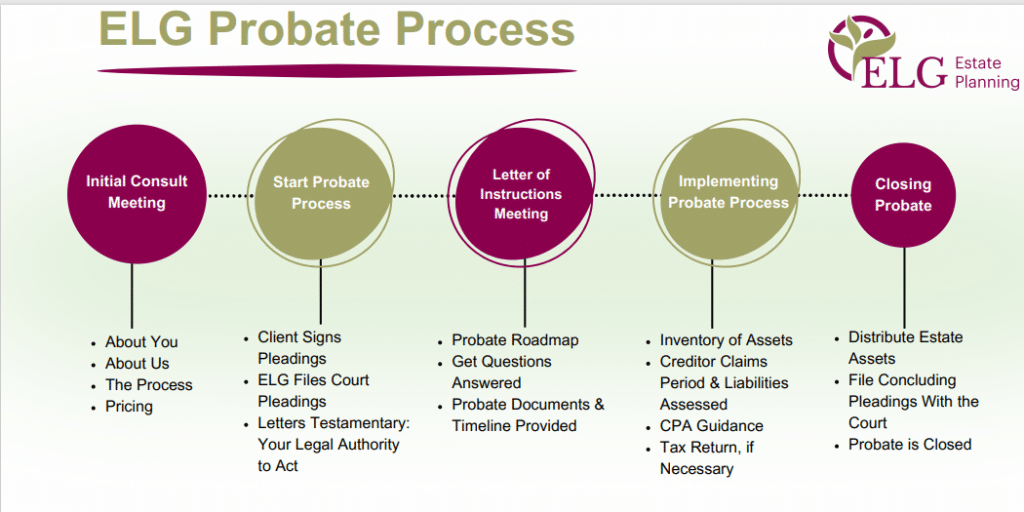
The probate process begins when a person petitions the court to open probate. When a decedent leaves a Will, the person nominated as the executor by the Will typically files the petition to open probate and admit the Will to probate (which recognizes the Will as the valid Last Will and Testament of the decedent). When a decedent does not leave a Will, an interested party, such as a surviving spouse or adult child, can file a probate petition and request an appointment as the estate’s personal representative. A probate petition must also state whether the decedent’s estate is solvent (has more assets than debts). If the court approves the petition, it will issue letters testamentary to the petitioner, appointing them the personal representative of the estate authorized to act on its behalf.
Once a personal representative receives their appointment from the court, they must notify all interested parties of the appointment, including any beneficiaries named in the decedent’s Will and the decedent’s heirs under the state’s intestacy law. The personal representative should also notify certain state agencies.
The personal representative will gather and inventory the decedent’s estate by reviewing financial records, property deeds/titles, and insurance policies and examining any safety deposit boxes owned by the decedent. The personal representative should also inventory the decedent’s personal property, especially items of higher value, such as artwork, jewelry, collectibles, antiques, and other valuable assets. Personal representatives must also determine the estate’s debts to evaluate the legitimacy of any claims filed against the estate. A personal representative must notify potential creditors, evaluate filed claims, and pay debts from estate assets.
Managing an estate during probate can involve tasks such as opening bank accounts, keeping financial records, and filing tax returns on behalf of the decedent (i.e., the decedent’s final income tax return) and the estate. Once the personal representative has paid all estate debts and expenses, they can distribute the remaining assets to beneficiaries per the decedent’s Will or heirs per state intestacy law. Upon making distributions to heirs/beneficiaries, a personal representative should obtain a receipt, waiver and release for the estate.
After distributing all estate assets, the personal representative files a declaration of completion and the court will close the estate and discharge the personal representative from further obligation.
Common Challenges of Probate
The probate process can involve numerous challenges for personal representatives and heirs/beneficiaries, including:
- Trouble identifying the personal representative: When a decedent fails to leave a Will, various family members may assert their right to serve as the personal representative of the decedent’s estate.
- Will contests: A Will contest may occur when an heir or beneficiary challenges the validity of a will or the interpretation of its provisions.
- Difficulty gathering assets: Personal representatives can find it challenging to locate all of a decedent’s estate assets, especially when they do not leave detailed financial records.
- Challenges to personal representative actions: Creditors or heirs/beneficiaries can file legal challenges to a personal representative’s decisions regarding the distribution of estate assets.
With a properly prepared Will, the above issues can be mitigated.
How Can a Shoreline Probate Attorney Help You?
A probate attorney from ELG Estate Planning can help you and your family navigate the estate administration process by:
- Reviewing your loved one’s Will to understand your rights and obligations as a personal representative
- Explaining your legal options and what to expect during probate to help you make informed decisions
- Walking you through each step of the estate administration process, from petitioning for letters testamentary to gathering your loved one’s estate to making distributions for creditor claims and to beneficiaries
- Advocating for your rights and interests, should legal challenges arise during probate, including beneficiary challenges to appointments or distributions of estate assets
Contact Our Firm Today to Learn More About Our Legal Services for Probate
If your loved one recently passed away in Shoreline, let an experienced probate attorney guide you through the estate and trust administration process. Contact ELG Estate Planning today for a confidential consultation to learn more about our estate and trust administration services.
Schedule An Appointment with our Seattle law office
Areas