
Losing someone you love is hard enough without the added stress of legal paperwork. Probate, which includes sorting out wills, paying bills, and distributing what’s left, is often required in Washington State unless your loved one already had a valid estate plan in place. Probate ensures that the deceased’s assets are distributed according to their will—or under state law if there is no will. Understanding this process can save you time, money, and unnecessary headaches during an already difficult time.
Many of us on the ELG Estate Planning team have helped our own parents as they aged or dealt with family incapacity issues firsthand. That’s why we treat your probate matters the way we’d want someone to treat our own family members—with compassionate care and practical guidance.
Whether you want your loved ones to avoid probate when you pass, or this is your first time handling the estate of someone who has passed, we’re here to help you during every step of the process. Call us today for a consultation to find out how we can help you avoid probate, administer an estate, and more.
Probate is typically required when a person dies owning assets solely in their name. This is common when those assets do not automatically transfer to another person, like when real estate is held in a joint deed with right of survivorship.
The process begins with filing the decedent’s will in the appropriate court. Washington requires that anyone who has “custody” of the will must deliver the will to the named executor or file it with the court within 30 days of when they learned of the death. If probate is necessary and no personal representative or executor is specified in the will, the court may appoint a personal representative (executor) to oversee estate administration.
However, not all estates require probate. In some cases, Washington law allows for simplified estate administration. If the total value of the deceased’s probate assets is under $100,000 and does not include any real property, the estate may be settled by using a small estate affidavit. This process allows heirs to collect assets without initiating probate.
Even if a will exists, probate may still be necessary. Here are some common situations:
Real property not held in trust: If the deceased owned a home or land solely in their name and it was not transferred into a revocable living trust, probate is required to legally transfer the property title.
No transfer-on-death (TOD) deeds: Washington allows TOD deeds to pass real estate outside of probate. If the property lacks this type of deed and is not held in trust, the property must go through probate.
Financial accounts without beneficiaries: Bank accounts, retirement accounts, and investment portfolios lacking payable-on-death (POD) or transfer-on-death (TOD) designations must be probated (assuming no joint owner exists).
Solely-owned personal property: Contested valuable personal effects, and other tangible assets without joint ownership or designated beneficiaries may also require probate.
Understanding whether probate is required can be complicated, especially when various types of assets are involved. ELG Estate Planning helps clients in Liberty Lake determine the most efficient path forward—whether that involves initiating probate or using other alternatives under Washington law.
ELG Estate Planning offers support for anyone navigating—or hoping to avoid—the probate process in Liberty Lake. Whether you are a personal representative managing a loved one’s estate or creating your own comprehensive estate plan, we can offer straightforward legal guidance.
Our firm assists with all aspects of probate, including advising personal representatives on their legal duties, preparing and filing all required court documents, managing statutory deadlines, and overseeing the valuation and distribution of assets. We can also coordinate the payment of valid debts and help you properly close the estate.
Ultimately, our approach respects the legal and emotional realities of estate administration. Continuity of care—from planning to administration—is at the heart of what we do, ensuring families are supported at every stage of the estate planning and administration process.
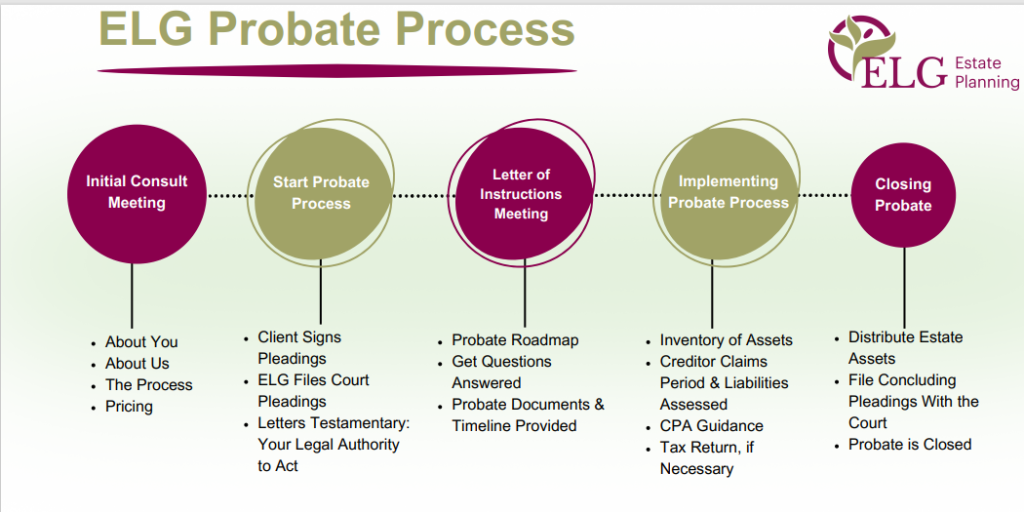
The probate process in Washington goes through several steps and eventually culminates in settling a deceased person’s estate. If you’re in Liberty Lake, probate is typically filed through the Spokane County Superior Court. While it can feel daunting, having experienced legal counsel helps you stay on track and comply with all statutory requirements. Here’s what to expect:
Petition for Probate: The first step is to file the will with the court and petition for probate. The court will appoint a personal representative if the will did not name an executor. They are responsible for administering the estate.
Notice to heirs and creditors: Next, the personal representative must publish a notice to creditors in a local newspaper and notify known heirs and beneficiaries. If the decedent received Medicaid, the Department of Social and Health Services (DSHS) must also be notified.
Inventory and appraisal: The personal representative must complete an inventory and appraisal of the estate. This includes real property, personal property, bank accounts, investments, and outstanding debts. This helps ensure the estate valuation is proper, which is key for tax and distribution purposes.
Paying debts and taxes: The estate must pay valid creditor claims in a designated order. Furthermore, the estate may owe taxes. Washington State imposes an estate tax on estates over the exemption threshold, which as of May 2025 is 2.19 million dollars, significantly lower than the federal estate tax exemption of 13.9 million dollars.
Distribution: Once debts and taxes are resolved, the personal representative distributes the remaining assets in accordance with the will. Alternatively, they may distribute the assets under state intestacy laws if no valid will exists.
Closing the estate: The last step is filing a final accounting and petitioning the court to close the estate. Once approved, the personal representative is discharged.
From filing deadlines to financial documentation, ELG Estate Planning provides hands-on support at every stage. If probate feels daunting, ELG can help clients plan ahead to avoid probate altogether by using tools like revocable trusts, beneficiary designations, and transfer-on-death deeds.
Probate can present challenges for grieving families, especially when emotions run high, and the estate plan is unclear. Disputes among heirs over the will’s validity or fairness are unfortunately common. Unclear or outdated estate planning documents can lead to court delays and unnecessary confusion.
The process is even more complex when heirs live out of state, or the estate includes property in multiple jurisdictions. Personal representatives may find themselves overwhelmed by legal and fiduciary responsibilities they never anticipated. These duties often include managing notices, court deadlines, and asset distribution—while also dealing with their own grief.
The team at ELG Estate Planning understands these pressures. With deep experience in both probate and elder law, our team handles the legal side of things so families can focus on themselves. We manage filings, publish notices, communicate with beneficiaries and creditors, and work to resolve the estate smoothly.
If you’re interested in probate administration—or how your Liberty Lake estate plan can avoid probate entirely—call ELG Estate Planning today. Our legal team is happy to explain your options.
Depending on the type of trust you create, you may be able to update and amend a trust during your lifetime. One of the key advantages of a revocable living trust is its flexibility. A revocable trust can be amended, modified, or fully revoked by the grantor at any time during their lifetime, as long as they remain mentally competent.
Common reasons to update a revocable living trust include:
Marriage, divorce, or remarriage
Birth or adoption of children or grandchildren
Substantial changes in assets, such as acquiring real estate or selling a business
Death or incapacity of a trustee or named beneficiary
Failing to update a trust can lead to unintended consequences after death or incapacity. The experienced estate planning attorneys at ELG Estate Planning can help you create and update revocable living trusts whenever these events occur.